
Industrial Intelligence Applied to tire manufacturing – VRAIA
Over 10 years driving intelligent quality control in the tire industry. Since 2015, we have been developing AI and computer vision solutions that help leading manufacturers in the industry improve quality, optimize production, and make more precise decisions in real time.
Industrial Intelligence powered by human expertise: Zero defects, maximum efficiency, and complete traceability.
- Hardware (Machinery)
- Intelligent tire inspection.
- TC – Marking identification and DOT reading.
- ITV – Complete tire inspection.
- Autobale – Rubber mixing system for tire manufacturing.
- GTC (Grinding Tire Control).
- Robot Marking System (RMS/RDA).
- Software
- X-Ray – Anomaly Detection
- Tagger App.
- Simulator App.
- Big Data Management & Machine App Connectivity.
Information objective, quantifiable, and visual to support technical decision-making
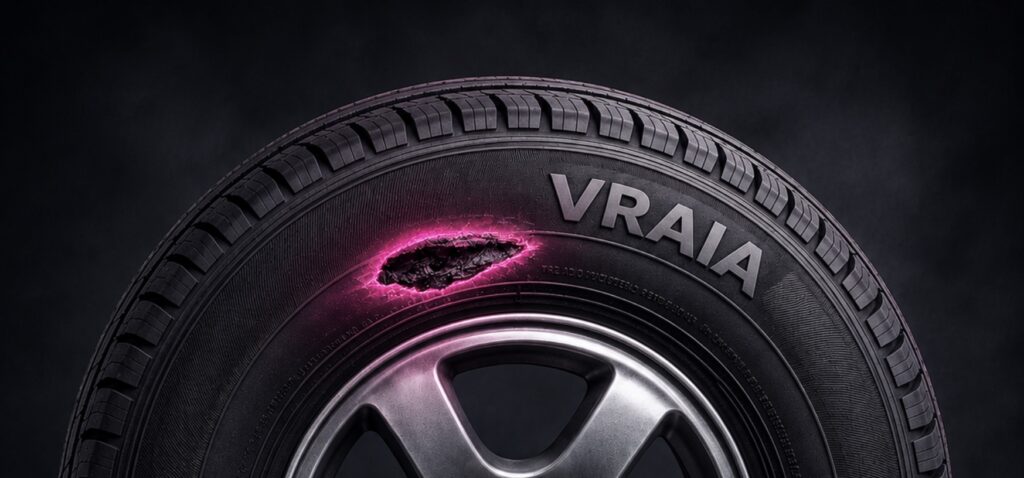
Final tyre inspection and quality control system. This system uses advanced artificial intelligence to identify tyre defects, as well as key manufacturing elements required to ensure the highest safety standards in production quality.
Cycle time: 13s/tire
Supported tire sizes: 500–980mm
Specification control: + 200 defect types
QTC Inspector (Quality Tire Control)
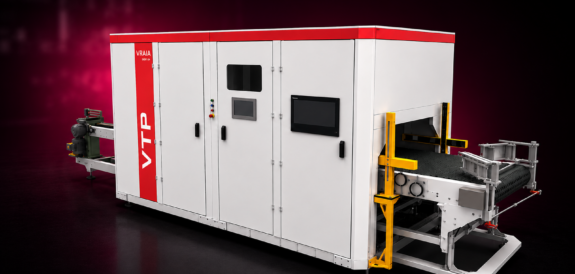
Computer vision for reading tire markings, DOT codes, and sidewall features.
Final tyre identification and quality control system. This system can recognise characters and markings on tyre sidewalls, as well as different manufacturing elements required to comply with market regulations.
Product Technical Specifications
- Cycle time: 3s/tire
- Supported tire sizes: 500-950mm
- Specification control: automated inspection of tread lines, color markings, and sidewall character OCR and OCV recognition (reading of DOT code, week/year, country of origin, tire dimensions, and corresponding mold number/drawing)
- Single-pass detection reliability: capable of autonomously classifying up to 250 defect types across the sidewall and tread
Plant Impact (ROI): manual inspection in traditional tire plants has an average defect escape rate of 1.6% due to operator fatigue.
VRAIA’s QTC Inspector automates this critical process under the industry's strictest standards, drastically reducing scrap while ensuring no defective tire ever reaches the road
Real-time tire inspection system for PTI

Auto Visual Inspection / ITV
Real-time tire metrology and road safety for vehicle inspection centers (PTI/MOT). We bring the rigorous control precision required by major automotive manufacturing plants to the Periodic Technical Inspection environment. Backed by a patent granted in 26 countries, our rapid-scanning system provides objective assistance to technicians, evaluating the physical integrity and metrological condition of the tires in under 15 seconds.
Technical Specifications
- Scanning cycle time: under 15 seconds per vehicle.
- Dimensional & anomaly detection: automated detection and classification of bulges, cracks, deformations, and irregular tire wear.
- Tread metrology: precise mathematical measurement of tire contact patch and actual tread groove depth.
- Sidewall data extraction: instantaneous extraction of size specifications, manufacturer, origin, and manufacturing date code (DOT).
- Road Safety Impact (ROI)
- Poor tire condition accounts for 2% of highway traffic accidents. Our system completely eliminates operator subjectivity during visual inspection—delivering objective, quantifiable, and visual data to empower inspector decision-making and safeguard drivers' lives.
Robotics, AI, and computer vision to automate mixer feeding
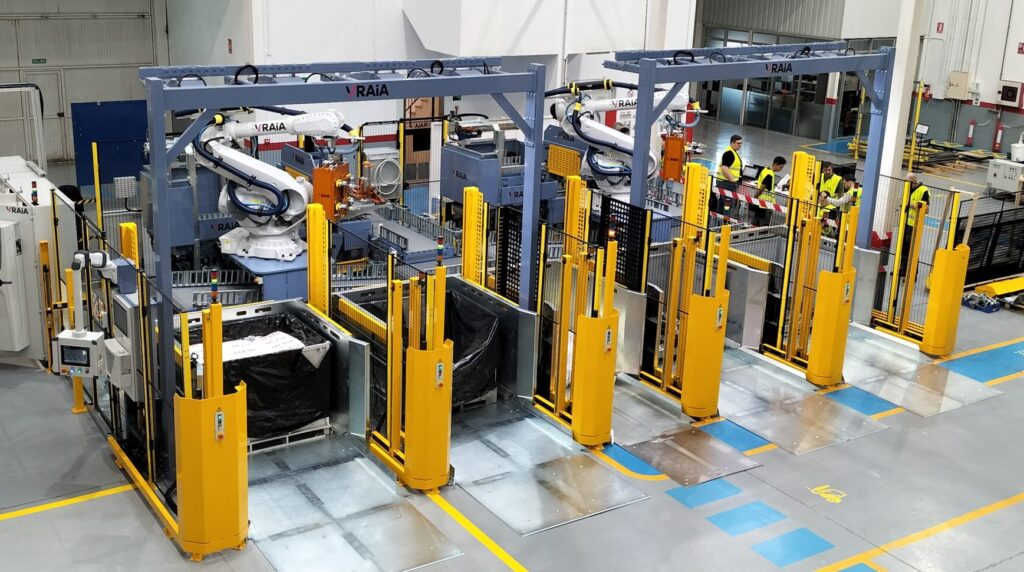
AMF (Autobale Mixer Feeder)
3D Machine Vision-Guided Robotic Loading, Weighing, and Cutting of Rubber Bales
The Autobale Mixer Feeder (AMF) is VRAIA’s standardized robotic solution for fully automating the loading of raw materials into the mixer (Internal Mixer or Banbury). Utilizing 3D vision guidance technology and Deep Learning algorithms, the robot acts with 100% autonomy to identify, extract, weigh, and cut the rubber blocks, feeding the mixer exactly according to the batch recipe.
Technical Specifications
- Average cycle time per batch:75 seconds.
- Complex formulation capability: autonomous feeding and portioning for recipes requiring up to 6 different rubber types per batch.
- Extreme cutting precision: integrated smart weighing system achieving a cut-weight tolerance of under 1%.
- Supported dimensional range: rubber bales up to 300 mm x 750 mm.
- Payload capacity: autonomous handling and insertion of bales weighing up to 35 kg.
- Occupational Health, Safety & ROI: lthe compounding room is historically the area with the highest rate of work-related injury leave due to the repetitive manual handling of 35 kg rubber bales. The AMF system fully automates this hazardous task, reducing physical strain-related sick leave in this section to zero while guaranteeing batch chemical homogeneity.
GTC (Grinding Tire Control)
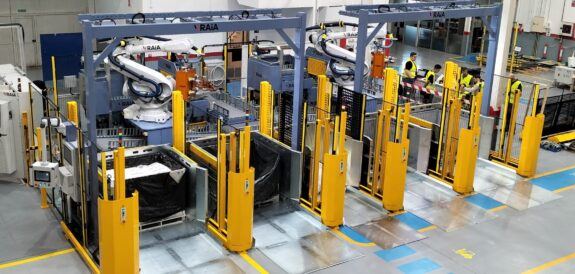
High-Precision 3D Laser Scanning for Automated Buffing and Retreading.
The Grinding Tire Control (GTC) system is a specialized robotics and 3D vision solution developed to intelligently automate the tire buffing and retreading process. Powered by a high-resolution 3D laser scanner, the system analyzes the tire to mathematically calculate precise machining specifications.
Technical Specifications
- Smart Buffing Calculation: the software calculates with micrometric precision the exact depth and volume of worn tread rubber to be removed.
- Material Specification: mathematically determines the exact dimensions and volume of new rubber compound required for tread rebuilding.
- Scanning Technology: high-speed 3D laser profilometers and integrated multispectral 2D cameras housed within a robotic cell.
- Rigorous Quality Standards: operates under strict defect control with a validated beta of 0.2% and passes alpha validation testing (with a maximum reject rate of 3% NG during overhauling).
- Maximum Operational Efficiency (ROI) Traditional manual retreading relies heavily on operator estimation, often leading to measurement errors, scrapped casings, or excessive consumption of expensive compound. The GTC system completely automates the process—optimizing raw material usage, minimizing scrap, and ensuring that every buffed casing meets the highest road safety standards.
Robot Marking System (RMS / RDA)

High-speed automatic tire marking via thermal transfer.
The Robot Marking System (RMS) is our standardized robotic cell designed for automated, permanent tire marking directly on inline conveyor systems. Powered by hot-stamping head technology and heavy-duty thermal transfer ribbons, the robot applies critical identification and traceability codes prior to final inspection.
Technical Specifications
- Ultra-Fast Cycle Time: high-speed stamping cycle completed in just 7 to 8 seconds per tire..
- Tire Processing Envelope: Accommodates Outer Diameters (OD) from 550 mm to 915 mm, section widths from 150 mm to 350 mm, and payloads from 5 kg to 35 kg.
- Supported Markings & Symbology: robotic application of uniformity and balance color dots (Red Dot, Yellow Dot, Blue Dot) and Inspector Stamps (IS stamp) over standard 20 x 20 marking areas.
- High-Uptime Continuous Operation: Heavy-duty spool capacity engineered for up to 2,500 stamps per ribbon, featuring rapid roll changeover completed in under 2 minutes.
- Integrated Control & Safety Architecture: automated ribbon-break and end-of-roll alarms linked to immediate conveyor line stop interlocks. Real-time synchronization with 7-digit barcode scanners for automated line sorting, routing, and unit bifurcation.
- Cost Reduction & Traceability ROI: manual application of uniformity dots and quality stamps represents a frequent source of human error in tire manufacturing plants, often triggering expensive rejection penalties from OEM automakers. The RMS automates this process with millimeter precision—eliminating manual labor overhead, preventing mislabeling errors, and guaranteeing end-to-end digital traceability for every tire produced.
X-ray image analysis for automated tire inspection
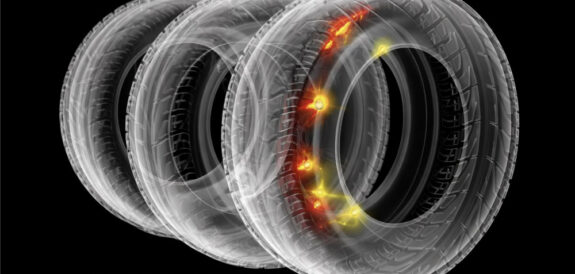
AI X-Ray Plug-In
Advanced Artificial Intelligence for Your Existing X-Ray Scanners.
The VRAIA X-Ray Plugin is a standardized software suite powered by Deep Learning neural networks, engineered for non-invasive integration with any tire X-ray machine currently in production. Operating autonomously and in real time, our algorithm processes radiographs to detect structural anomalies, air trapped inclusions, and internal casing defects with metrological accuracy.
Software Technical Specifications
- Universal Compatibility: Compatible with all OEM brands and models of industrial X-ray inspection machinery on the market.
- Real-Time Neural Detection: Algorithms trained on a massive historical dataset of thousands of radiographs to identify internal steel cord deformities and rubber structure anomalies in milliseconds.
- Centralized Cloud Dashboard: integrates an interactive visual dashboard connected to the industrial network for real-time tracking of quality statistics and failure history.
- Financial & Operational Impact (ROI): lindustrial X-ray inspection vaults represent high-CapEx assets that are extremely costly to replace. Furthermore, procuring new physical machinery entails months of plant downtime alongside complex radiological safety recertifications and nuclear regulatory approvals. VRAIA software elevates legacy scanners to Industry 4.0 standards without multi-million-dollar hardware investments—immediately multiplying internal inspection reliability.
Tagger App — Neural Network Training & Dataset Management

Full autonomy for your quality engineers to retrain AI models.
The Tagger App is a proprietary software tool fully integrated within VRAIA’s METAMORPH suite. Engineered with a 100% visual and intuitive workflow, it enables plant quality engineers and chief inspectors to autonomously "teach" and fine-tune computer vision algorithms on-site, eliminating reliance on third-party software developers.
Tool Specifications
- User role: Designed for the Plant Quality Super Inspector profile.
- Simplified Visual Interface: Drag-and-drop environment for labeling OK/NG tire images straight from the production line.
- Evolutionary Retraining: Allows defining new defect criteria, reclassifying defect types, and updating vision booth neural networks locally within minutes.
- Reduction of Technological Dependency (ROI): In traditional computer vision systems, every time the plant introduces a new tire reference or detects a new defect, it must hire support services from the software vendor to reprogram the machine. With Tagger App, your own team has the power to update the system's intelligence, reducing external technical maintenance costs to zero.
Simulator App (digital twins)

Simulator App is the virtual and interactive environment based on digital twins of the METAMORPH suite by VRAIA. Used by quality assurance departments, the application allows recreating the operation of machines in three dimensions and testing Artificial Intelligence algorithms using virtual synthetic data before their physical deployment.
Software Specifications
- User role: Specific to the Quality Assurance profile.
- Synthetic data training: Generates high-definition virtual scenarios with millions of combinations of tires and simulated defects to validate computer vision neural learning.
- Physical logic simulation: Recreates the behavior of robots (such as the AMF or RMS) and conveyor belts to verify cycle times and branching logics virtually.
- Time-to-Market Acceleration and Safety (ROI): Testing programming logic and new computer vision models directly on the live production line halts production and carries the physical risk of robotic arm collisions. Simulator App eliminates this financial risk by 100%, enabling infinite simulations in a safe virtual environment, which reduces physical commissioning times from months to just a few days.
Big Data Management & Machine App Connectivity

Full interoperability of your machines with ERP (SAP, Odoo, Oracle) and MES systems
This centralized connectivity module acts as the data backbone for the entire VRAIA METAMORPH software ecosystem. Its function is to provide a real-time, bidirectional communication infrastructure that natively connects tire plant machinery with enterprise management systems.
Connectivity Specifications
- User role: Specific to operations management, executive management, and manufacturing control (Manufacturing / QA / MF Control).
- Universal Industrial Connectivity: Native connection to line PLCs, industrial sensors, robotic arms, and plant SQL databases.
- Native ERP/MES Integration: Automatic data synchronization with platforms such as SAP, Odoo, Oracle, and Manufacturing Execution Systems (MES).
- Interactive Cloud Dashboard: Centralizes production statistics (defect rate per batch, rubber recipes loaded into AMF, traceability history for each tire), securely accessible from the cloud.
- Real Data-Driven Decision Making (ROI): eThe major challenge facing modern industrial plants is that machine data remains isolated on the factory floor. Big Data Management provides leadership with quantifiable, structured, and visual real-time insight into plant operations. This enables immediate identification of bottlenecks, automated billing, and quality audits with complete transparency for your clients.
About industrial intelligence applied to tire manufacturing
What is VRAIA's METAMORPH suite and what kind of plants can implement it?
It is our comprehensive software, artificial intelligence, and computer vision ecosystem designed specifically for the tire industry. We offer modular solutions covering everything from the initial mixing room to quality control and final inspection, as well as solutions tailored for ITV/MOT testing stations.
Is it necessary to replace our existing industrial machinery to use VRAIA's AI?
No. Many of our solutions, such as the AI X-Ray Plug-In, are designed to connect non-invasively to pre-existing scanners, PLCs, and vision equipment in your plant, upgrading your assets to the Industry 4.0 standard without the need to replace hardware.
What is the real impact of these solutions on plant costs (ROI)?
Our solutions eliminate human error and operator fatigue, achieving:
Final inspection (QTC): elimination of the ~1.6% defect escape rate.
Mixing room (AMF): reduction to zero of sick leave due to weight handling and cutting precision with an error of less than 1%.
Retreading (GTC): mínimo scrap through 3D laser micrometric measurement.
What is the scope of VRAIA's solutions in the tire sector?
We offer total coverage across the value chain: from raw materials in the mixing room (AMF), el marcado (RMS), visual/X-ray inspection (QTC y X-Ray) and retreading (GTC), to road safety control at ITV inspection stations. ITV.